
Start an East Haven Resident Search
There is no single public list of everyone connected with East Haven. A parcel card can identify an assessed owner and a map key. A voter lookup can confirm a registration status and polling place for an eligible search. A deed index can show a grantor, grantee, lien, or legal description. A directory or newspaper can place a household at an address in an earlier year. Begin with the question, then use the source built for that question.
A name search works best when it gains a second anchor. Add a street, a middle initial, a date, an MBL, a unique identifier, a court venue, or a directory year. An address search should keep the exact number and street, then record whether the result is a situs address, mailing address, legal description, or postal label. That small distinction prevents a tax record, historical line, or old phone entry from being mistaken for proof of a current household.
- Search the East Haven Property Record Cards site by owner, location, street, MBL, or unique identifier.
- Use the Connecticut voter lookup for its limited registration, party, and polling-place purpose.
- Check the Town Clerk and SearchIQS index for deeds, maps, mortgages, releases, and liens.
- Pair a dated address with Hagaman, the Historical Society, newspapers, directories, or probate.
- Ask the correct custodian for a copy or public-record request when the online index stops.
Note: An index hit is a lead until its date, record type, and custodian match the question being researched.
East Haven Record Offices and Their Roles
East Haven’s local record trail begins with the Town Clerk, not a New Haven County recorder. Connecticut has no active county-government recording layer. The Town Clerk records and indexes land records, maps, trade names, liens, military discharges, vital records, town filings, agendas, minutes, and election materials. The Assessor maintains property descriptions, values, field cards, sales and permit summaries, while the Registrar of Voters maintains the Official Voters List and election records. Each office can point to a person or place, but none is a complete resident directory.
The East Haven Town Clerk is at 250 Main Street, with posted weekday hours of 8:30 a.m. to 4:30 p.m.; land recording stops at 3:45 p.m. The office lists a rear drop box, phone and email routing, a land-record room, and an electronic vital-record route. Confirm hours, fees, and eligibility before visiting because the 2026 fee schedule and record-specific rules control the request.
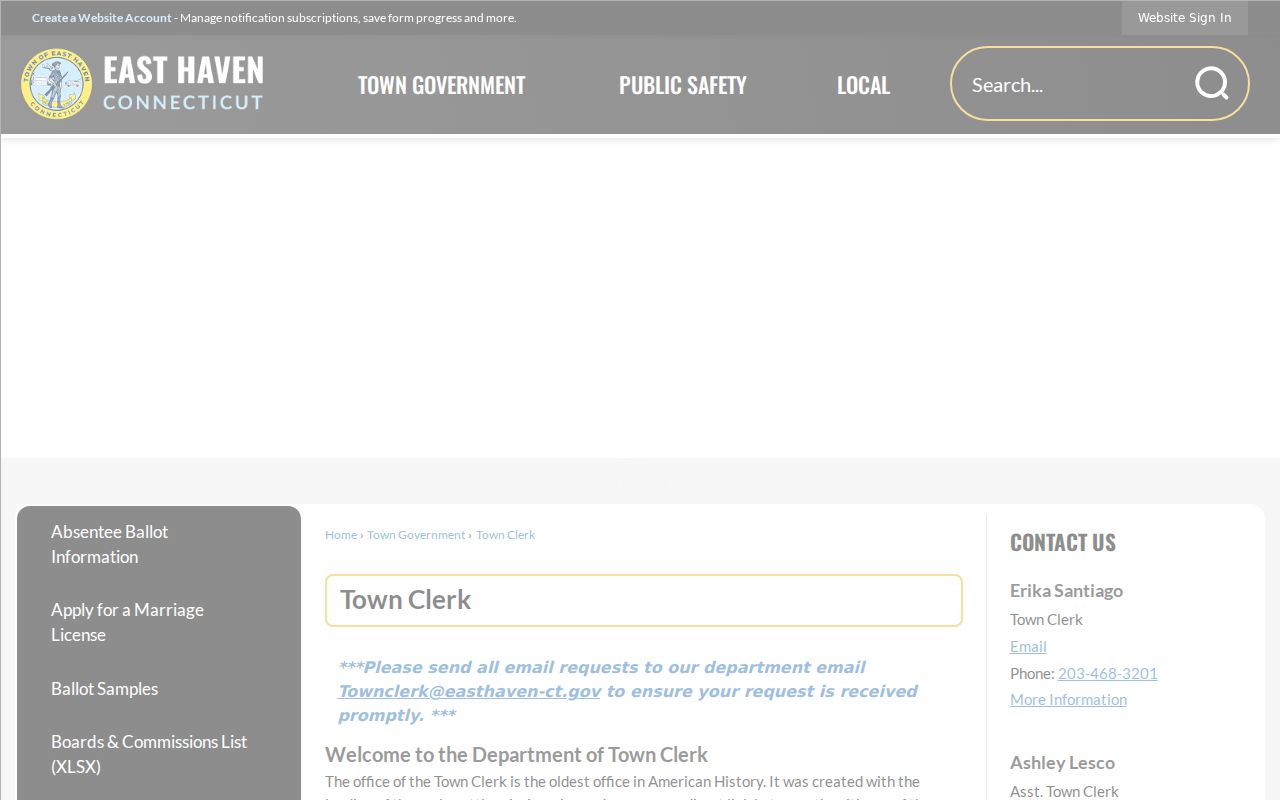
The office is both an online starting point and a physical fallback when an index, image, or form needs staff confirmation.
East Haven Town Clerk
250 Main Street
East Haven, CT 06512
203-468-3201
Land and vital records
East Haven Assessor
250 Main Street
East Haven, CT 06512
203-468-3233
Property Record Cards
East Haven Registrar of Voters
250 Main Street, lower level
East Haven, CT 06512
203-468-3320
Connecticut voter lookup
The Town Clerk custody page is the safest place to confirm which local office owns a question. A county label may still matter for court or historical research, but it does not identify a county assessor, county recorder, or county jail office for East Haven.
Search East Haven Parcels by MBL
The Property Record Cards portal is the strongest current parcel discovery tool. It accepts an owner last or first name, location number, street name, unit, MBL, unique identifier, property use, and condominium complex. Sales searches add date and price ranges, acreage, zone, design type, living area, year built, rooms, bedrooms, and baths. Results can return a street, number, unit, name, unique ID, MBL, use, acreage, zone, buildings, and condominium complex. The instructions favor one category at a time and a last-name-only owner search.
GIS adds the spatial bridge. The East Haven GIS portal searches by name, house number, street, MBL, or unique ID. Its map reports parcel maps updated in June 2025, property information updated nightly, and about 11,310 parcels. The interactive map supplies parcel selection, adjacent geometry, zoning, sales-year symbols, aerials from 1934 through 2023, original tax maps, flood layers, and environmental layers. The card and deed control legal and tax facts; the map supplies geography.
| Portal field | What to enter | What it helps connect |
|---|---|---|
| Owner name | Last name, first name | Assessed owner record and parcel result |
| Location | Number, street, unit | Situs address and street-level search |
| MBL | Municipal block and lot key | Assessor, GIS, tax, and deed research |
| Unique identifier | East Haven parcel ID | Card-to-map bridge when a street number changes |
| Property use | Residential, public, retail, and other choices | Separate parcel type from a person’s identity |
The tax portal is a separate discovery route for real estate, personal property, motor vehicles, account numbers, DBAs, tax IDs, and balance status. A bill name is not a deed, and a card mailing address is not a complete list of occupants. Preserve the identifier that joins the systems instead of copying a name without its parcel context.
The Property Record Cards search screen shows the fields that make a street or name query repeatable.
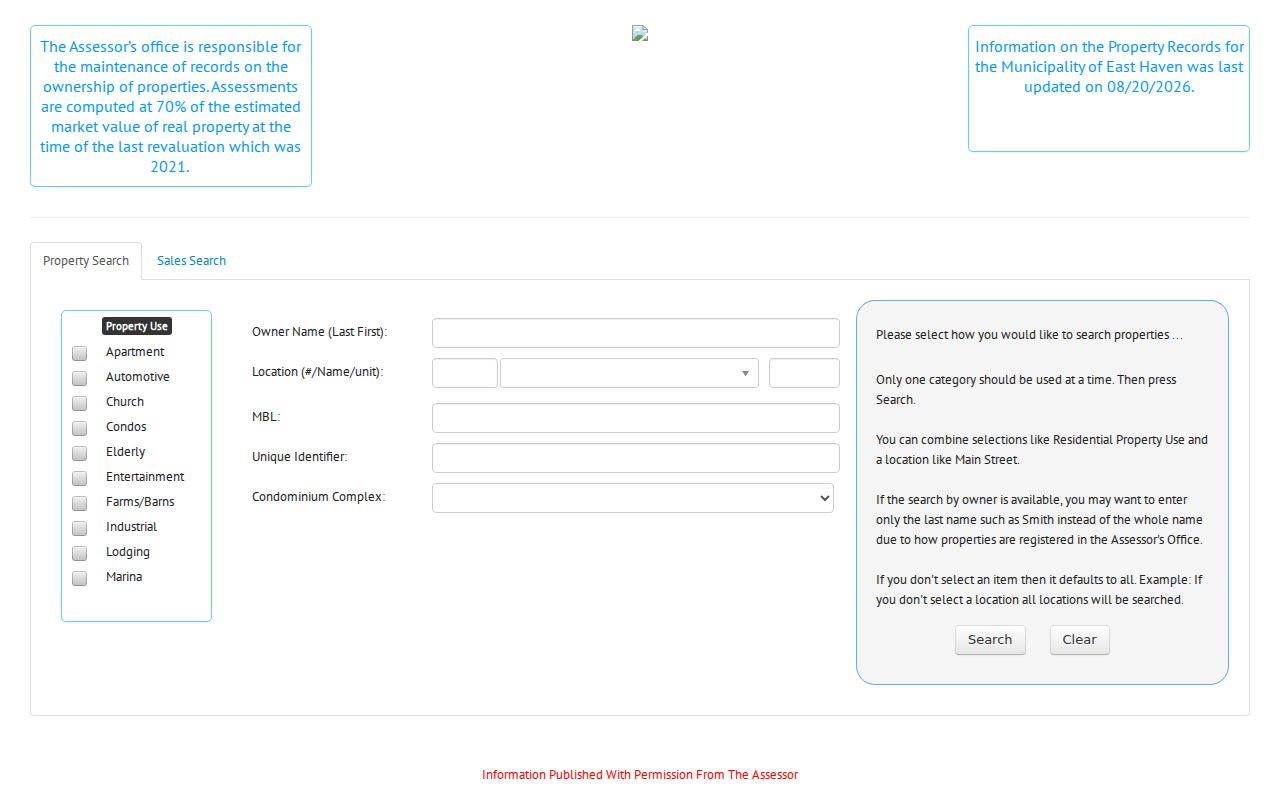
Those owner, location, MBL, and use choices let a researcher compare a current card with GIS and the Town Clerk index without treating one result as the whole story.
The East Haven tax portal supplies a different set of property and account search choices.
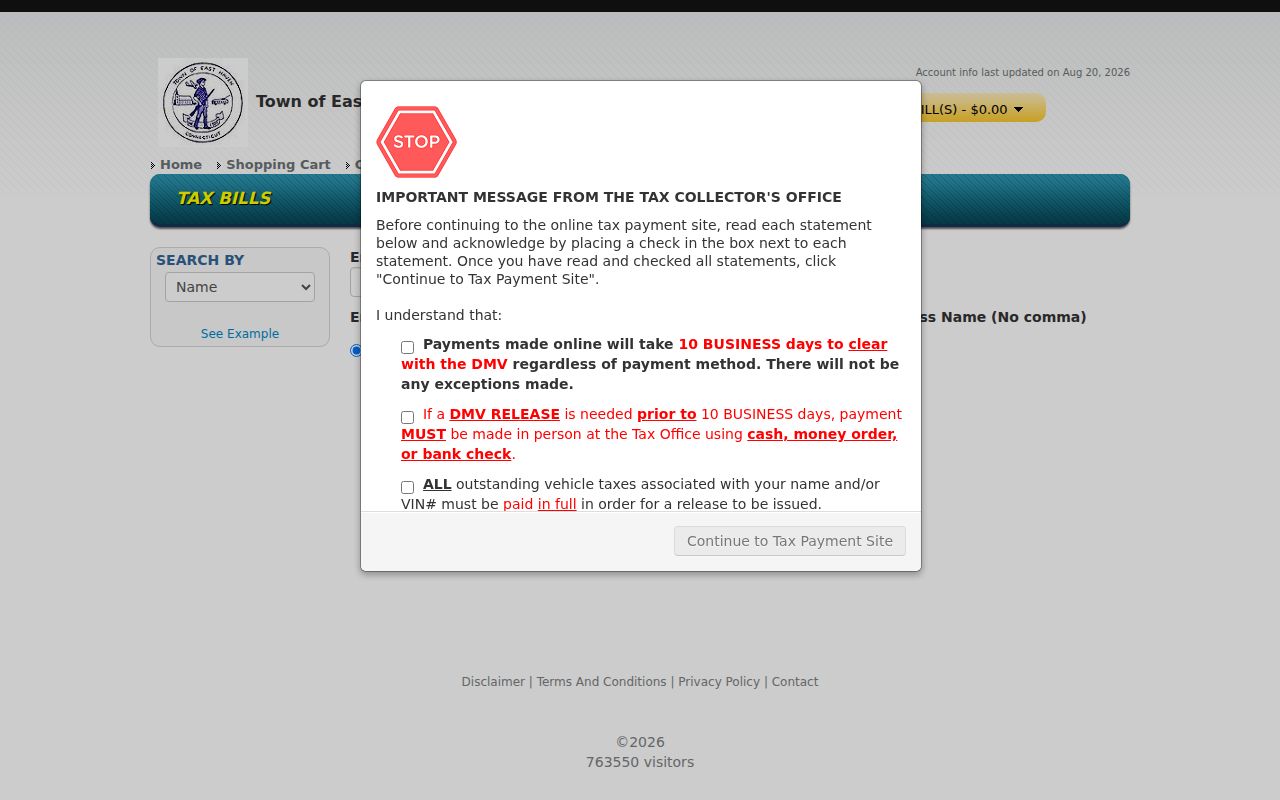
Tax status can help locate a bill record, but the Town Clerk’s recorded deed remains the source for a conveyance and legal description.
East Haven’s Voter Route Has Two Levels
The public Connecticut Secretary of the State lookup is narrower than the full voter file. It is meant to check registration status, party affiliation, and polling information. The East Haven Registrar of Voters maintains and certifies the local Official Voters List, conducts the annual canvass, and keeps poll strips, sample ballots, moderator returns, election statistics, and district material. The town’s voting-district PDF connects a street and address range to a polling place and district, but it does not publish a resident roster.
Month and day of birth are protected from public voter information under current guidance, while the year may be released. The full statewide file requires a written request, a $300 charge, and an election-related, scholarly, journalistic, political, or governmental purpose. The request form restricts private or commercial use, harassment, advertising, solicitation, sale, and marketing. That boundary matters: voter data is an election record, not a general contact list.
List maintenance also changes the meaning of a result. Town updates can reflect a new registration, a move, a death notice, DMV notice, NCOA confirmation, an annual-canvass postcard, inactive status, or later removal. Record the search date and the polling geography. A no-result or inactive result is time-sensitive and should not be read as a complete statement about a person’s life or address.
Note: The public lookup and the $300 statewide file are different access products with different fields, purposes, and restrictions.
Current East Haven Directory Sources
Current directory-like sources describe different relationships. The assessor card centers on a taxable parcel. A deed index centers on a recorded transaction. The voter lookup centers on an election record. A court, license, business, or unclaimed-property system has its own legal purpose. A useful East Haven residents directory therefore labels each line by source and date instead of combining every name into one list.
| Source | Relationship shown | Keeper | Access |
|---|---|---|---|
| Property Record Cards | Assessed owner, parcel, building, sale, permit summary | East Haven Assessor | Online and office records |
| Land-record index | Grantor, grantee, lien, map, legal description | Town Clerk / SearchIQS | Guest index and image options |
| Voter lookup | Registration, party, polling place | Connecticut SOTS and local Registrar | Public lookup, limited file access |
| Court and probate indexes | Case party, venue, status, type, or estate index row | Judicial Branch and Probate District 36 | Online index and clerk route |
| Business and license search | Entity, credential, status, address, filing | SOTS and DCP | Public state portals |
For a name-only question, the resident lookup route should combine a dated parcel, court, vital, probate, license, business, or historical record. For a street question, keep the address key and work parcel by parcel. A roster assembled without those distinctions can make a historical, postal, or tax association look current when it is not.
East Haven Courts and Probate Indexes
East Haven civil and family matters use the New Haven Judicial District. The Connecticut civil inquiry system offers party, docket, property-address, court-event, legal-notice, short-calendar, and foreclosure-sale searches. Party search uses a required last name, optional first name, location, category, case type, sort order, and matching modes such as Starts With, Contains, Is Equal To, and Sounds Like. East Haven cases generally use the New Haven venue. The result is a public index, not the official file, so the clerk remains the verification point.
Geographical Area 23 handles applicable criminal and motor-vehicle matters. Pending defendant searches use last name, first initial, birth year, year range, court location, and category. A docket number is a better anchor than a name alone. Older material may require a courthouse counter, public terminal, clerk call, or State Library finding aid. Sealed, erased, restricted, or removed material will not appear as a normal search result.
Probate District 36 serves East Haven and North Haven from 595 Thompson Avenue. Its public lookup begins January 5, 2011 and accepts district, case type, status, last name, and first name. A visible index row can show a case number, type, district, and open or closed status. It does not establish heirship, a current address, or the outcome of a full estate file.
The East Haven-North Haven Probate District lookup is the source for the index fields and status filters.
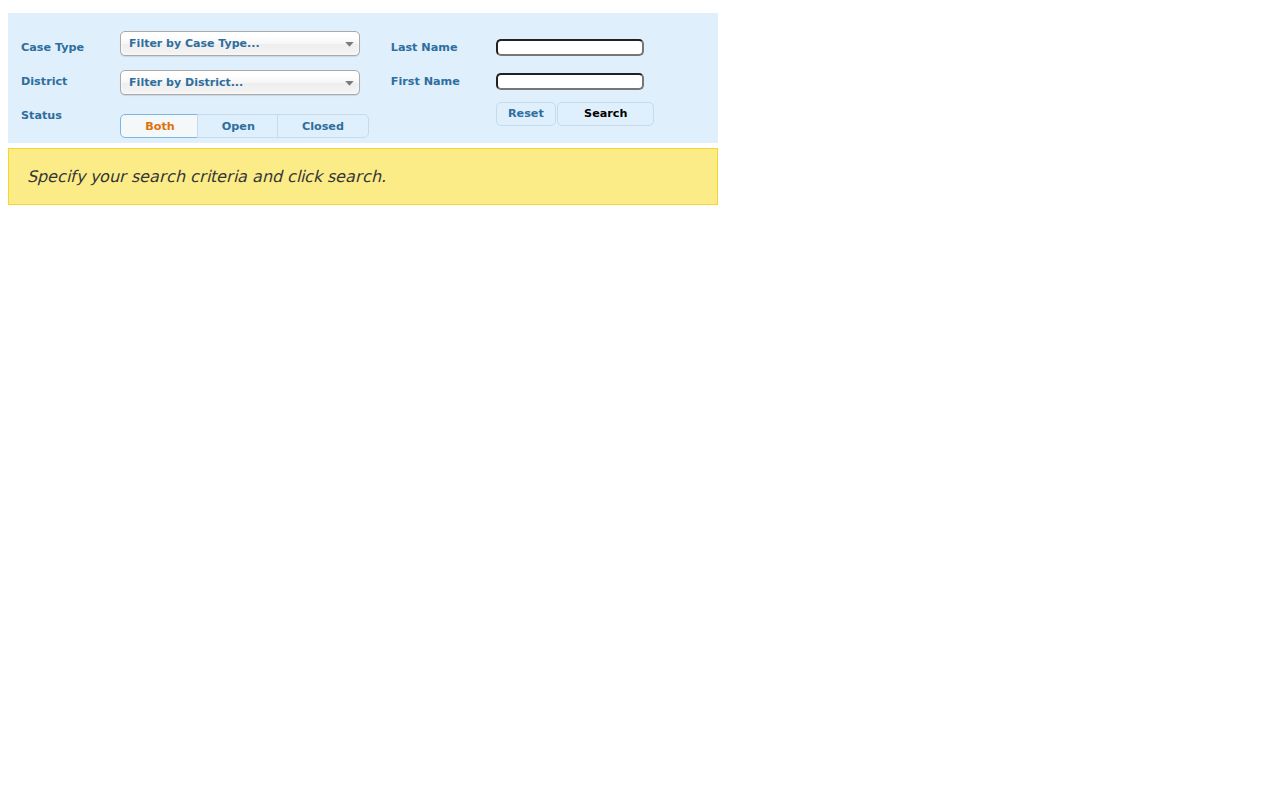
A probate search can be a useful family-history lead when its case number and district are preserved, followed by a request to the probate clerk for any file the rules allow.
East Haven Certificates and Vital Access
The Town Clerk keeps local birth, marriage, and death records, while the Connecticut Department of Public Health holds statewide records from July 1, 1897 forward. The local electronic route is available through the town’s vital-record vendor; mail, in-person, and phone or email routing remain useful when a form or identity rule is unclear. The event town and event date decide which office should receive the request.
Birth and fetal-death records younger than 100 years have restricted access under chapter 93, with eligibility for the subject, specified relatives or representatives, approved researchers, and other listed categories. Adults may generally request certified marriage and death copies, but Social Security numbers remain protected. A post-July 1, 1997 death record limits the Social Security number to the informant, surviving spouse, next of kin, or authorized representative. Adoption, parentage, surrogacy, and sex-marker records may have extra confidentiality rules.
The local schedule and forms list a $20 full birth copy, $15 wallet birth card, and $20 local marriage or death copy, with state DPH fees and processing rules differing by record. A public directory should explain the route, not reproduce sensitive certificate fields. The current East Haven forms page helps route a requester to the correct application.
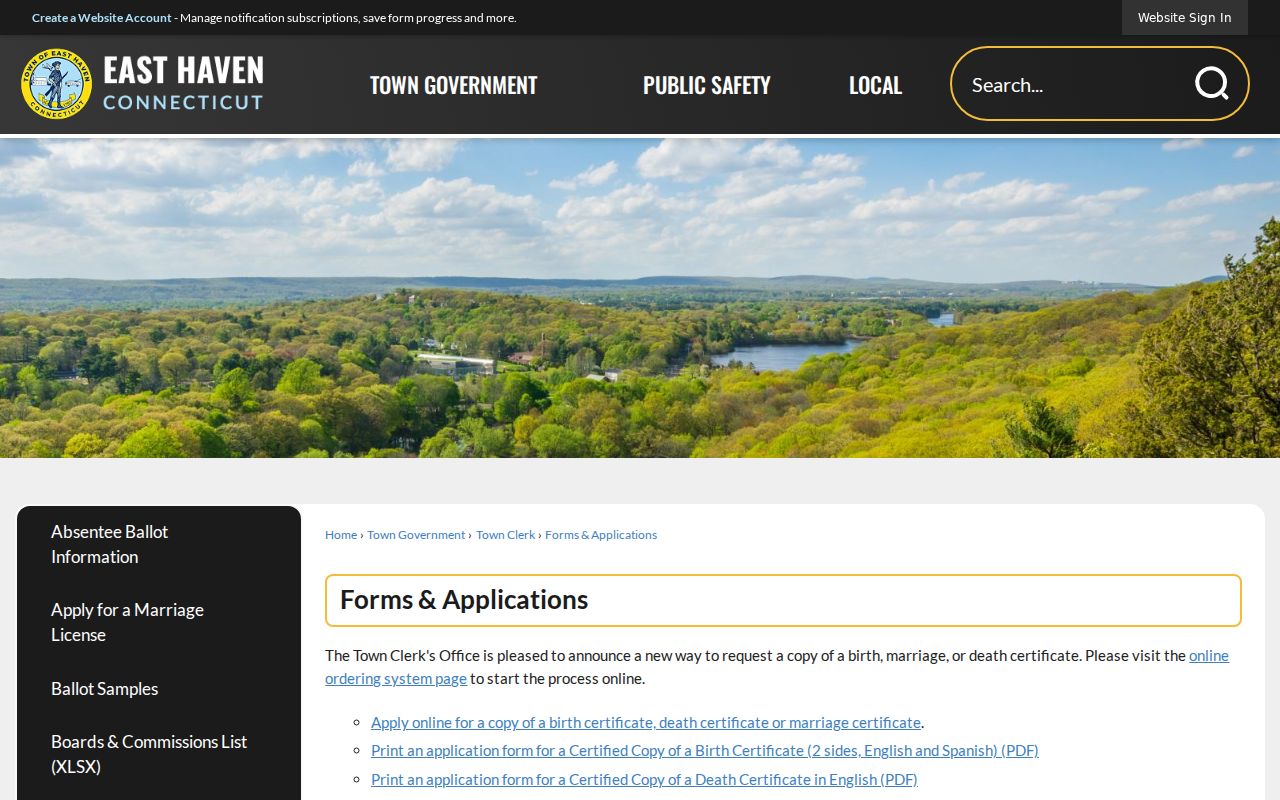
The forms show why identity, relationship, payment, and certificate type should be settled before a request is mailed. FOIA cannot be used to bypass a chapter 93 restriction.
East Haven News and Local History Clues
Hagaman Memorial Library is the main local-history connector at 227 Main Street. Its home page advertises remote MyHeritage Library Edition access for cardholders, and its digital files include East Haven News issues. The Historical Society’s research center at the R. Vernon Hays School adds photographs, historic people, school and neighborhood material, the Old Cemetery theme, and local compilations. These sources can reconnect a family name with a dated place without pretending that a newspaper or directory is a current roll.
Inspected issues from 1939, 1946, 1951, and 1952 show names, addresses, public meetings, permits, annual reports, and community notices. The Library of Congress telephone directory collection also contains a 1931-1932 New Haven District volume with an East Haven locality and a sample historical entry. Read the scan, not just OCR, and retain the issue date or volume range. The full historical shelf, directory runs, and entry-reading method are treated on the East Haven city directory page.
For older place names, remember that East Haven incorporated in 1785 and ceded Fair Haven, Granniss Corners, and Morris Cove to New Haven in 1881. A directory, newspaper, or obituary can use a New Haven label for a person or neighborhood that later research connects with East Haven. Library staff and the Historical Society can confirm whether a physical directory, microfilm reel, obituary file, yearbook, parish register, or cemetery record is available.
East Haven’s 06512 and 06513 Address Split
East Haven addresses most often use 06512, while verified town documents also use 06513 for places in Foxon and boundary areas. Postal output for 06513 can say New Haven even when the municipal situs is East Haven. That is a label difference, not proof that the parcel belongs to a different town. Use the USPS address tool for delivery output, the Assessor and GIS for the municipal parcel, and the Town Clerk for the legal description.
Neighborhood words such as Foxon, Center, Momauguin, Cosey Beach, and shoreline are useful research terms, but they are not substitutes for a street, number, MBL, or unique identifier. An old directory may print a former neighborhood or postal convention. A Census ZCTA is a statistical approximation, not an exact postal or municipal boundary. Keep the authority behind each label in the research note.
Note: A valid East Haven situs can carry a New Haven postal label, so address-level USPS verification matters more than town-name inference.
East Haven Businesses, Licenses, and Property
A person may appear in a business filing or license record without that record being a residence record. Business.CT.gov searches an entity by name, ALEI, or filing number and can show a principal, registered agent, formation date, type, address, and annual reports. The Town Clerk and SearchIQS list local trade-name records from February 10, 1977. Connecticut eLicense searches credential type, number, status, name, address, city, ZIP, and country, with results that can show dates, scope, supervisor, and mailing address.
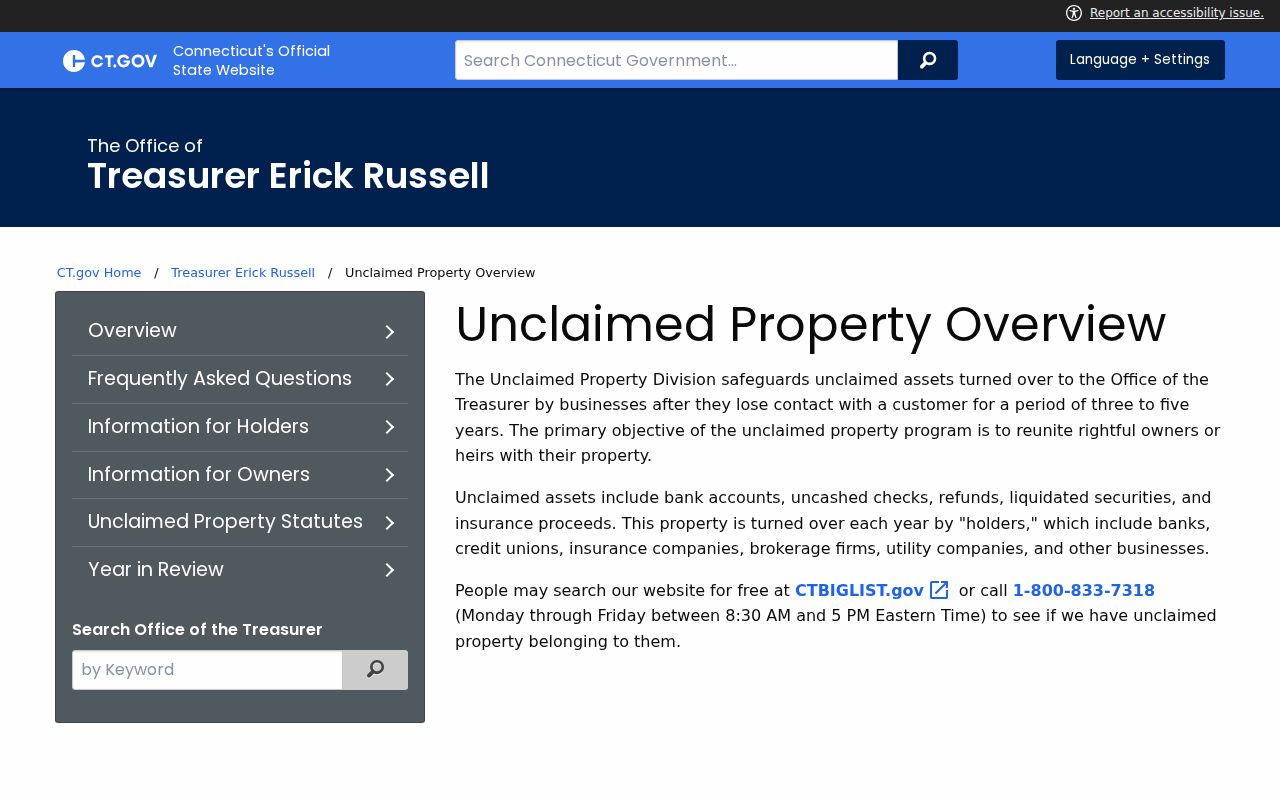
The State Treasurer’s CTBigList is a free official unclaimed-property search. A possible name or city match is only a lead, and the claim process controls identity proof. It should never be turned into a public list of claim details. Use the official domain typed separately when a notice asks for money or card information.
The Connecticut unclaimed-property overview explains the free search route.
For business context, the Connecticut business-search route separates entity data from personal records.
These systems help verify an organization or credential at a stated date. They do not prove that a person lives at the listed mailing address.
| Comparison | Official source | Commercial people-finder category |
|---|---|---|
| Provenance | Named custodian and record type | Mixed sources and unclear update path |
| Cost | Often a free index, statutory copy fee, or stated request charge | Free teaser, subscription, or one-time charge may apply |
| Correction | Challenge the record with the custodian | Suppression may hide a result without changing the source |
East Haven’s Growth Leaves a Directory Trail
East Haven’s record volume changed with its population. State historical figures list 1,167 residents in 1900, 1,795 in 1910, 3,520 in 1920, 7,815 in 1930, 9,094 in 1940, 12,212 in 1950, and 21,388 in 1960. Census QuickFacts gives a 2020 base of 27,939 and a July 1, 2025 estimate of 27,925. Those numbers describe scale, not a named resident list, but they explain why printed directories, newspapers, assessment cards, and modern databases each capture a different slice.
The town’s older industrial and shoreline history also leaves names in business notices, maps, schools, neighborhood references, and local reports. The 1934 aerial layer and later GIS imagery can be paired with a deed, directory, or newspaper to show how a place changed. That is a stronger family-history method than reading a current card as if it described every past household.
The 2026 Assessor revaluation is a timely reminder to preserve the card’s date. A value or building description may change while the underlying deed chain does not. Record both the portal update date and the original record date whenever a current East Haven directory entry depends on a property snapshot.
East Haven Records: Safe at Home Limits
Public access has limits. Connecticut’s Address Confidentiality Program gives eligible participants a substitute mailing address and special protection for certain voter and marriage records. The separate Voter Privacy Program can protect an official voter-registry address when disclosure would endanger a person or family. A protected voter may still appear in another lawful record, but that does not justify trying to reconstruct a hidden address.
Connecticut’s Data Privacy Act gives qualifying consumers rights to access, correct, delete, obtain a copy, learn data categories, and opt out of sale, targeted advertising, or profiling from covered businesses. Those rights do not erase a Town Clerk deed, court index, or other government record automatically. A correction request goes to the custodian named on the record, with the source, date, and evidence of the error.
Lawful personal use. East Haven public records are for lawful research, family history, civic understanding, and similar purposes. Do not use a record to stalk, harass, intimidate, or harm another person, and do not treat a public line as permission for repeated contact.
The East Haven Records Trail Has Limits
Every record answers a narrow question. A deed shows a recorded transfer, not every occupant. An assessor card shows a tax and building snapshot, not a complete household. GIS shows parcel geography, not private utility or delivery data. A directory gives a dated address line, while a voter record reflects an election relationship that may later change. Court, police, custody, registry, license, and vital systems have their own purpose and disclosure rules.
When an online source fails, use the documented fallback. Contact the Town Clerk, Assessor, Registrar, Building or Planning office, Police Records, Judicial Branch clerk, Probate District 36, Hagaman Memorial Library, Historical Society, or State Library. For non-exempt municipal records not already posted, Connecticut FOIA, chapter 14, provides an inspection and copying route subject to exemptions and fees. The FOI Commission explains prompt access and the copying rules.
The Connecticut FOI Commission FAQ is the source for request guidance and access limits.
Use a source name, URL, search date, and record date in your notes. That habit keeps a directory useful when portals, fees, voter fields, and assessment values change.
- Roll
- A record set maintained for a defined purpose, such as assessment or election administration.
- Index
- A searchable pointer to a record, often less complete than the underlying image or file.
- Parcel
- A mapped unit of land identified by a situs, MBL, unique ID, or legal description.
- Criss-cross directory
- A historical address-to-name tool that can complement ordinary name-to-address directories.